

Why B2B Marketing Strategy Matters for Small Business Success
B2B marketing strategy small business is about promoting your products or services to other companies, not individual consumers. Unlike B2C marketing, B2B focuses on building long-term relationships, addressing complex business needs, and navigating longer sales cycles with multiple decision-makers.
Quick Answer: Essential B2B Marketing Strategies for Small Businesses
- Define Your Target Audience – Create detailed buyer personas and Ideal Customer Profiles (ICPs).
- Build Your Online Presence – Optimize your website for SEO and establish thought leadership through content.
- Leverage Cost-Effective Channels – Focus on LinkedIn, email marketing, and content marketing, typically investing 5-10% of revenue.
- Nurture Relationships – Use personalized email campaigns and consistent follow-up.
- Prove Your Value – Showcase testimonials, case studies, and customer success stories.
- Measure and Optimize – Track KPIs like conversion rates, CAC, and CLV to improve ROI.
If you are running a small business and selling to other companies, you face unique challenges. Your sales cycle is longer: the average B2B decision-making journey takes about 2.5 months. You are not selling to one person; you are convincing entire buying committees. And you are doing all this with limited resources.
The good news is that 80% of people look at a website when checking out service providers, and effective B2B marketing does not require a massive budget. It requires strategy, consistency, and focus on the right channels.
The biggest mistake small B2B businesses make is trying to do everything at once. Successful B2B marketing is about building trust, demonstrating expertise, and staying top-of-mind throughout that lengthy decision process. Research shows that firms conducting systematic research on their prospects grow three to ten times faster than those that do not.
This guide explains how to build a B2B marketing strategy that works for small businesses without breaking the bank.
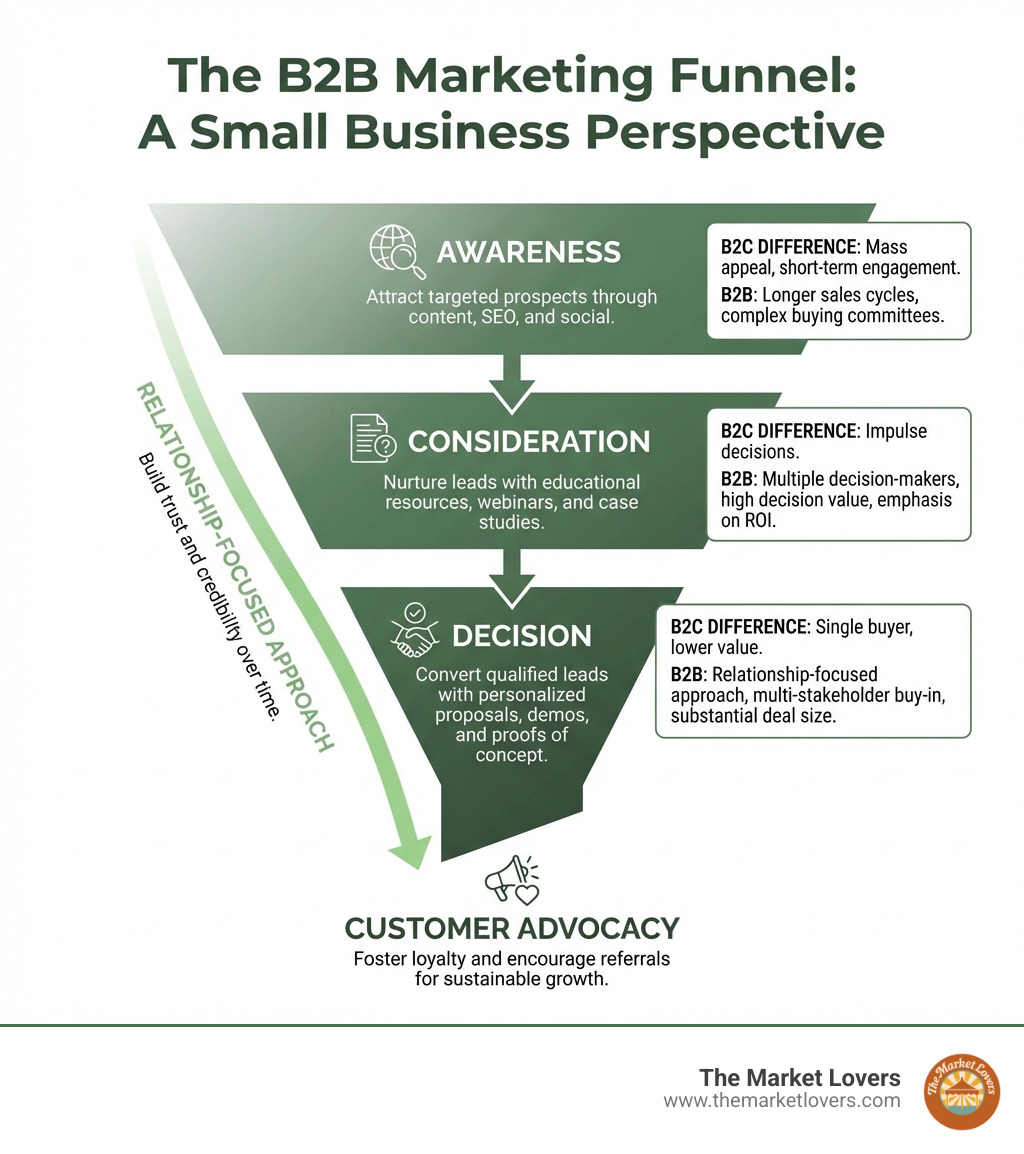
The Blueprint: Defining Your Brand, Audience, and Value Proposition
When we talk about a b2b marketing strategy small business, we’re diving into a different world than selling to individual consumers. Think of it like this: selling a single cupcake to a hungry passerby (B2C) is very different from selling a catering service for a corporate event to a company (B2B). The stakes are higher, the decision-makers are more numerous, and the motivations are rooted in logic and return on investment (ROI).
The core purpose of B2B marketing is to align our marketing efforts with our company’s overall business objectives. It’s a long-term vision, a blueprint for how we’ll create value, drive growth, and achieve a competitive edge.
B2B vs. B2C: Understanding the Fundamental Differences
While both B2B and B2C marketing aim to persuade, their approaches diverge significantly. In B2C, we often appeal to emotion, impulse, and immediate gratification. In B2B, the focus shifts to efficiency, ROI, and long-term partnerships.
Contrary to popular belief, B2B decisions aren’t entirely devoid of emotion. As research from Harvard Business Review highlights, “personal concerns that business customers bring to the purchase process are increasingly important.” Decision-makers are still people, and factors like enhancing their reputation, reducing anxiety, or even simple trust can play a crucial role. However, these emotions are tied to business outcomes, not just personal desires.
The average B2B sales cycle can take an average of 2.5 months, sometimes much longer, involving multiple stakeholders. This contrasts sharply with B2C, where purchases are often quicker and involve fewer individuals.
Here’s a quick overview of the key differences:
| Feature | B2B Marketing | B2C Marketing |
|---|---|---|
| Audience | Organizations, businesses, decision-makers | Individual consumers |
| Sales Cycle | Longer, more complex (weeks, months, years) | Shorter, often impulse-driven |
| Motivation | Logic, ROI, efficiency, problem-solving, value | Emotion, desire, entertainment, convenience |
| Decision-Makers | Multiple stakeholders, buying committees | Individual or small household |
| Relationship | Long-term, partnership-focused | Transactional, short-term |
| Price Point | Often higher, complex contracts | Generally lower, simpler pricing |
How to Identify and Understand Your B2B Target Audience
Before we even think about tactics, we need to know exactly who we’re talking to. This is where creating an Ideal Customer Profile (ICP) and detailed buyer personas comes in handy. An ICP defines the type of company that would benefit most from our services, while buyer personas dig into the specific roles and individuals within those companies.
To truly understand our audience, we need to dig deep into their:
- Pain Points: What problems are they trying to solve? What keeps them up at night? Tools like Answer the Public can help us uncover phrases people use on search engines, giving us direct insight into their challenges.
- Needs and Goals: What are they hoping to achieve? How does our solution fit into their larger business objectives?
- Motivations: Beyond the logical, what personal concerns (like career advancement or reducing risk) might influence their decision?
- Buying Process: Who is involved in the decision? What information do they need at each stage?
We can gather this information through systematic market research. This isn’t just a nice-to-have; it’s a growth accelerator. Firms that conduct systematic research on their prospects and clients grow three to ten times faster and are up to two times more profitable than peers that don’t pursue research. This research helps us understand customer needs, motivations, and preferences, allowing us to tailor our offerings and go-to-market strategy.
Finally, we must identify our Unique Value Proposition (UVP). This is what makes our business stand out, what gives clients a compelling reason to choose us. Can we articulate the specific solution we provide? How is it different from our competitors? Can we promise, and then deliver on, tangible value? This forms the bedrock of our brand identity, dictating our consistent message, voice, and visual presentation across all channels.
Core Components of a Cost-Effective B2B marketing strategy small business

For small businesses, every marketing dollar counts. We need a B2B marketing strategy small business that is not only effective but also cost-efficient. This means prioritizing, focusing on channels with a strong ROI, and adopting a multi-channel approach that makes the most of our limited resources. It is encouraging to note that 76% of SMBs are investing more in technology this year than last, indicating a growing recognition of the power of digital tools.
A common approach for budget allocation is to dedicate a percentage of our revenue to marketing, typically between 5% and 10%. This can vary based on our industry, stage of growth, and specific objectives.
Leveraging SEO and Content Marketing for Inbound Leads
In the B2B world, buyers are constantly researching online. This makes Search Engine Optimization (SEO) and content marketing indispensable. SEO ensures our website is found by the right people at the right time. When potential clients search for solutions to their business challenges, we want our business to appear prominently.
Our website serves as the hub of our online presence, demonstrating our expertise and building credibility. It needs to be findable, informative, and user-friendly. This means:
- On-page SEO: Optimizing individual web pages to rank higher. This involves keyword research (what terms are our audience searching for?), using those keywords in title tags, meta descriptions, header tags, and body content, and creating concise, effective URLs. Tools like Google Keyword Planner can be incredibly helpful here.
- Off-page SEO: Actions taken outside our website to improve rankings, primarily earning high-quality backlinks from reputable sources. These links act as votes of confidence for our site.
- Technical SEO: Ensuring our website’s backend is optimized for search engines, including site structure, page speed, and mobile-friendliness.
- Local SEO: If we serve a specific geographic area, optimizing our Google My Business profile with up-to-date information, photos, and reviews is crucial.
Content marketing is where we establish our thought leadership and educate potential clients. B2B customers typically look for in-depth, reliable information that aids their business decisions. By producing valuable content, we become trusted authorities. This can take many forms:
- Blog Posts: Covering topics our audience cares about, aligning with our products or services.
- White Papers: In-depth reports on complex industry topics, often gated to generate leads.
- Case Studies: Real-world examples demonstrating how our product or service delivered tangible results for previous clients.
- How-to Guides and Ebooks: Providing practical solutions and showcasing our expertise.
This combination of SEO and content marketing is a powerful engine for attracting inbound leads, allowing prospects to find us organically as they seek solutions.
Nurturing Relationships with Email and Social Media Marketing
Once we have captured attention, the next step in our b2b marketing strategy small business is nurturing those leads. B2B sales cycles are long, so consistent, valuable communication is key.
Email marketing is a core tool here. It is remarkably cost-effective, generating an average of $36 for every dollar spent. For some B2B industries, this ROI can be even higher: software and technology often see 40:1, and marketing, PR, and advertising agencies can achieve 42:1. An estimated 93% of B2B marketers use email, making it a cornerstone of lead nurturing.
Effective email strategies include:
- Personalization and Segmentation: Sending targeted messages based on a lead’s industry, role, or stage in the buying process. We can use drip campaigns (automated series of emails) to deliver content relevant to their journey.
- Value-Driven Content: Our emails should not just be sales pitches. They should offer valuable insights, link to our latest blog posts, or invite people to webinars.
- Compliance: Always adhere to regulations like the CAN-SPAM Act, ensuring our emails are clearly identified, include physical addresses, and offer easy opt-out options. Even cold emails are permissible if they are personalized, valuable, and comply with these rules.
Social media, particularly LinkedIn, is another powerful tool. While over 60% of buyers check out new service providers on social media, LinkedIn stands out for B2B due to its professional focus. It is where decision-makers gather, network, and consume industry-specific content.
On LinkedIn, we can:
- Share Thought Leadership: Post articles, insights, and company news to establish ourselves as experts.
- Engage Directly: Participate in relevant groups, comment on industry discussions, and connect with potential clients.
- Leverage Video: 70% of companies used the platform to share video in 2024, which shows its effectiveness.
- Schedule Posts: Tools like Buffer can help us maintain a consistent presence without constant manual effort.
Building Credibility with Social Proof and Networking

In the B2B world, trust is everything. Clients want assurance that we can deliver on our promises. This is where social proof and personal connections become invaluable parts of our B2B marketing strategy small business.
- Customer Testimonials and Case Studies: These are key for credibility. Testimonials provide quick, positive endorsements, while detailed case studies illustrate the specific problems we solved and the measurable results we achieved for past clients. We should actively encourage customers to share their honest feedback, perhaps with a quick follow-up email after a purchase.
- Online Reviews: Platforms like Google Reviews offer powerful social proof. We can encourage clients to leave reviews, and importantly, we should respond to them, showing we value feedback.
- Networking Events and Industry Conferences: While digital marketing is crucial, face-to-face interaction still holds immense power in B2B. These events allow us to:
- Build Rapport: Start conversations, understand pain points directly, and establish authentic connections.
- Demonstrate Expertise: Speak on panels, host workshops, or engage in discussions to showcase our knowledge.
- Expand Our Reach: Meet potential partners, referrers, and clients in a natural setting.
Building these relationships and demonstrating our capabilities authentically helps foster trust, which is at the heart of B2B success. For us at TheMarketLovers, empowering local shopping through connected networks is part of our story, emphasizing the power of community and authentic connections.
Advanced Strategies to Amplify Your Reach and ROI
As our small business grows, we will want to scale our marketing efforts, target higher-value accounts, and gain even greater efficiency. This often involves embracing more sophisticated strategies and technologies.
Implementing Account-Based Marketing (ABM) for High-Value Targets
Account-Based Marketing (ABM) is a focused strategy for small businesses targeting a specific list of high-value accounts. Instead of casting a wide net, ABM treats each individual prospect or customer account as a “market of one,” tailoring personalized campaigns directly to them.
The three pillars of ABM success are:
- Understand Your Buyers: This requires deep research into each high-value account, identifying key decision-makers, their specific needs, pain points, and the overall buying committee.
- Align Marketing, Sales, and Service: For ABM to work, our marketing, sales, and customer service teams must work together seamlessly. They need a shared view of target accounts and a coordinated engagement strategy. As research from LinkedIn and Ipsos shows, prioritizing high-value accounts is the number one habit of top sellers.
- Grow Account Relationships: ABM is not just about closing the initial deal. It is about nurturing that relationship throughout the entire customer lifecycle, ensuring consistent engagement and addressing evolving needs.
By focusing our resources on a select group of ideal clients, we can create highly relevant and impactful campaigns that lead to higher conversion rates and stronger, more profitable relationships.
The Role of AI, Automation, and Partnerships in Growth
The future of B2B marketing strategy small business is increasingly shaped by technology. AI and marketing automation are no longer just for big corporations; they are becoming essential for small businesses looking to compete effectively.
- AI in Marketing: AI can improve personalization, predict trends, and power chatbots for customer service. From AI-driven lead scoring to content ideation, these tools can help us scale our efforts, personalize outreach, and automate repetitive tasks, freeing up time for strategic thinking. Recent surveys indicate that 81% of B2B marketing teams now use generative AI tools, signaling a clear shift in the industry.
- Marketing Automation: This replaces high-touch, repetitive manual processes with automated workflows. Examples include automated email sequences, social media scheduling, and lead qualification forms. Automation centralizes our online marketing, making it easier to create, manage, and measure campaigns.
- Strategic Partnerships and Collaborations: Teaming up with complementary businesses can expand our reach and credibility. This could involve:
- Joint Webinars or Content: Creating valuable resources together that benefit both audiences.
- Cross-Promotion: Sharing each other’s services or products with our respective client bases.
- Referral Agreements: Formalizing a system where partners refer clients to each other.
These collaborations allow us to tap into new markets and leverage existing trust, providing a cost-effective way to grow.
A practical guide to creating a B2B marketing strategy small business
Building an effective B2B marketing strategy small business from scratch might seem daunting, but it is achievable with a structured approach. Here are the essential steps we recommend:
- Define Your Target Audience and UVP: Start by creating your ICPs and buyer personas. Clearly articulate what makes your business unique and why clients should choose you.
- Set SMART Goals: Establish specific, measurable, achievable, relevant, and time-bound goals. For example, aim to “Increase qualified leads by 20% through our website in the next six months.”
- Allocate Your Budget: Determine how much you can realistically invest, remembering the 5-10% of revenue guideline. Prioritize based on potential ROI.
- Choose Your Channels: Based on your audience and budget, select two to four primary channels (for example, LinkedIn, email, SEO and content, or networking). Avoid spreading yourself too thin.
- Develop a Content Calendar: Plan your content (blog posts, emails, social media updates) in advance, ensuring it aligns with your goals and the buyer’s journey.
- Build Your Online Presence: Create or optimize your website for SEO, ensuring it is a hub of information and expertise.
- Implement and Track: Launch your campaigns and carefully track their performance using analytics tools.
- Optimize Based on Data: Continuously review your KPIs, identify what is working and what is not, and refine your strategy accordingly. Marketing is an iterative process, not a one-and-done task.
Measuring Success and Preparing for the Future
What gets measured gets managed and improved. For any B2B marketing strategy small business, data-driven decisions are essential. We need to continuously monitor our efforts, adapt to market changes, and refine our approach to stay competitive. This requires building in flexibility, as rigid strategies often struggle in dynamic environments.
Key Data Analytics for Measuring Your B2B marketing strategy small business
To understand the impact of our marketing efforts, we need to track Key Performance Indicators (KPIs). These metrics provide insights into what is working and what needs adjustment. Some crucial KPIs for B2B small businesses include:
- Website Traffic: How many people are visiting our site, where they are coming from, and what pages they are viewing.
- Conversion Rates: The percentage of visitors taking desired actions, such as downloading a white paper, filling out a contact form, or requesting a demo.
- Lead Sources: Which channels are generating the most qualified leads.
- Cost Per Acquisition (CPA): How much it costs to acquire a new customer through a specific channel.
- Customer Lifetime Value (CLV): How much revenue we can expect from a customer over their entire relationship with us.
- Engagement Rates: For content and social media, how many people are interacting with our posts, emails, or videos.
Tools like Google Analytics are essential for gathering and analyzing this data. By regularly reviewing these metrics, we can make informed decisions, optimize our campaigns, and ensure our marketing budget is spent effectively.
Top Trends Shaping the Future of B2B Marketing
The B2B marketing landscape is constantly evolving, and for small businesses, staying aware of trends can provide a competitive advantage. Here are some key developments shaping the future:
- Video Marketing: This is now a mainstream channel. 89% of businesses use video as a marketing tool, and it is effective for B2B. From product demos and explainer videos to client testimonials and thought leadership snippets, video helps simplify complex ideas and build emotional connections.
- Podcasting: With busy professionals often consuming content on the go, podcasts are gaining popularity. They offer a way to share our expertise, build a deeper connection with our audience, and establish ourselves as thought leaders. We do not need a fancy studio to start; free tools like Audacity and Anchor can help us get going.
- Increased Personalization: By leveraging data and AI, we can deliver increasingly personalized experiences to our prospects and clients. This goes beyond using their name in an email and includes tailoring content, offers, and communications to their specific needs and stage in the buyer’s journey.
- Omnichannel Experience: Our clients interact with us across multiple touchpoints, including our website, email, social media, and events. An omnichannel strategy ensures a seamless, consistent, and integrated experience across all these channels, making their journey with us smoother.
- Brand-Led Storytelling: In a crowded market, simply listing features is not enough. B2B brands are focusing more on authentic storytelling, articulating their purpose, values, and impact. This helps create meaningful connections and differentiates us from the competition.
By embracing these trends, we can ensure our B2B marketing strategy small business remains agile, effective, and ready for future growth.
Frequently Asked Questions about B2B Marketing for Small Businesses
What are the most cost-effective B2B marketing strategies for a small business?
For a small business with limited resources, focusing on strategies that offer high ROI and leverage existing assets is key. These include:
- Content Marketing and SEO: Creating valuable blog posts, guides, and case studies that address client pain points, making your business findable through search engines.
- Email Marketing: Nurturing leads with personalized and segmented email campaigns, which can offer an excellent return on investment.
- LinkedIn Networking: Building professional connections, sharing thought leadership, and engaging in relevant industry discussions.
- Leveraging Existing Customer Relationships: Asking for referrals and testimonials from satisfied clients, which is powerful and often free.
How long is a typical B2B sales cycle?
The average B2B sales cycle can take about 2.5 months, but it can easily extend to several months or even years, especially for high-value or complex solutions. This longer cycle is due to the involvement of multiple decision-makers, higher price points, and the need for thorough evaluation and due diligence by the purchasing company. This is why relationship-building and consistent lead nurturing are crucial for B2B success.
How do I start building a B2B marketing strategy from scratch?
Starting from scratch is an opportunity to build a focused plan. Here are the essential steps:
- Define Your Target Audience: Create detailed Ideal Customer Profiles (ICPs) and buyer personas to understand who you are selling to.
- Set Clear, Measurable Goals: Use the SMART framework (Specific, Measurable, Achievable, Relevant, Time-bound) to define what you want your marketing to accomplish.
- Establish a Budget: Determine a realistic marketing budget, perhaps starting with 5-10% of your projected revenue.
- Choose Key Channels: Select a small number of marketing channels that best reach your target audience and align with your budget, such as SEO, LinkedIn, and email marketing.
- Create a Content Calendar: Plan your content to ensure consistency and relevance across your chosen channels.
- Implement and Track: Launch your initial campaigns and monitor your Key Performance Indicators (KPIs) using tools like Google Analytics.
- Optimize Based on Data: Regularly review your results, learn what works, and refine your strategy. Treat it as an ongoing process of improvement.
Conclusion
Cracking the code of B2B marketing strategy small business isn’t about having the biggest budget; it’s about having the smartest strategy. By understanding the fundamental differences between B2B and B2C, deeply knowing our target audience, and focusing on cost-effective, relationship-driven channels, we can build a powerful marketing engine.
From leveraging SEO and content to attract inbound leads, to nurturing relationships with personalized email and strategic social media, and ultimately building credibility through social proof and networking, every step contributes to long-term growth. Embracing advanced strategies like ABM, AI, and strategic partnerships further amplifies our reach and efficiency.
At The Market Lovers, we believe in empowering small businesses to thrive. We understand the unique challenges you face, and our goal is to provide the educational resources and community connections that help you succeed. By focusing on value, building trust, and continuously optimizing our efforts, we can open up immense potential.
Ready to take your B2B marketing to the next level? Explore more resources to grow your business with us, and let’s build something great together.