

Why Content Marketing Local Business Matters More Than Ever
Content marketing for local business is a strategic approach focused on creating and sharing valuable content to attract, engage, and retain customers in your geographic area.
Quick Answer: What Local Businesses Need to Do
- Create valuable local content – Blog posts, guides, and stories that help your community
- Optimize for local search – Use location-specific keywords and maintain your Google Business Profile
- Engage on social media – Share content on platforms where your local customers spend time
- Build trust with reviews – Encourage and showcase customer testimonials
- Measure and adjust – Track what works and refine your strategy over time
Imagine a steady stream of new customers and increased sales for your small business. This was the reality for David, an Austin bakery owner. Facing stagnant sales, he turned to content marketing. By starting a blog with recipes and tips and engaging on social media, he saw increased website traffic, a larger following, and most importantly, more sales.
Feeling disconnected from potential customers is common. With Google’s search market share at 84.69% and more than half of web traffic coming from mobile devices, your local customers are searching online first. The challenge is cutting through the noise to become their first choice.
Content marketing is more than just blog posts; it’s about becoming a trusted local resource. It’s about appearing in searches like “best coffee shop near me” and building genuine connections that create loyal customers.
The good news is you already have the key ingredients: your expertise, local knowledge, and unique story. Content marketing is the tool to share them with the people who need them most.
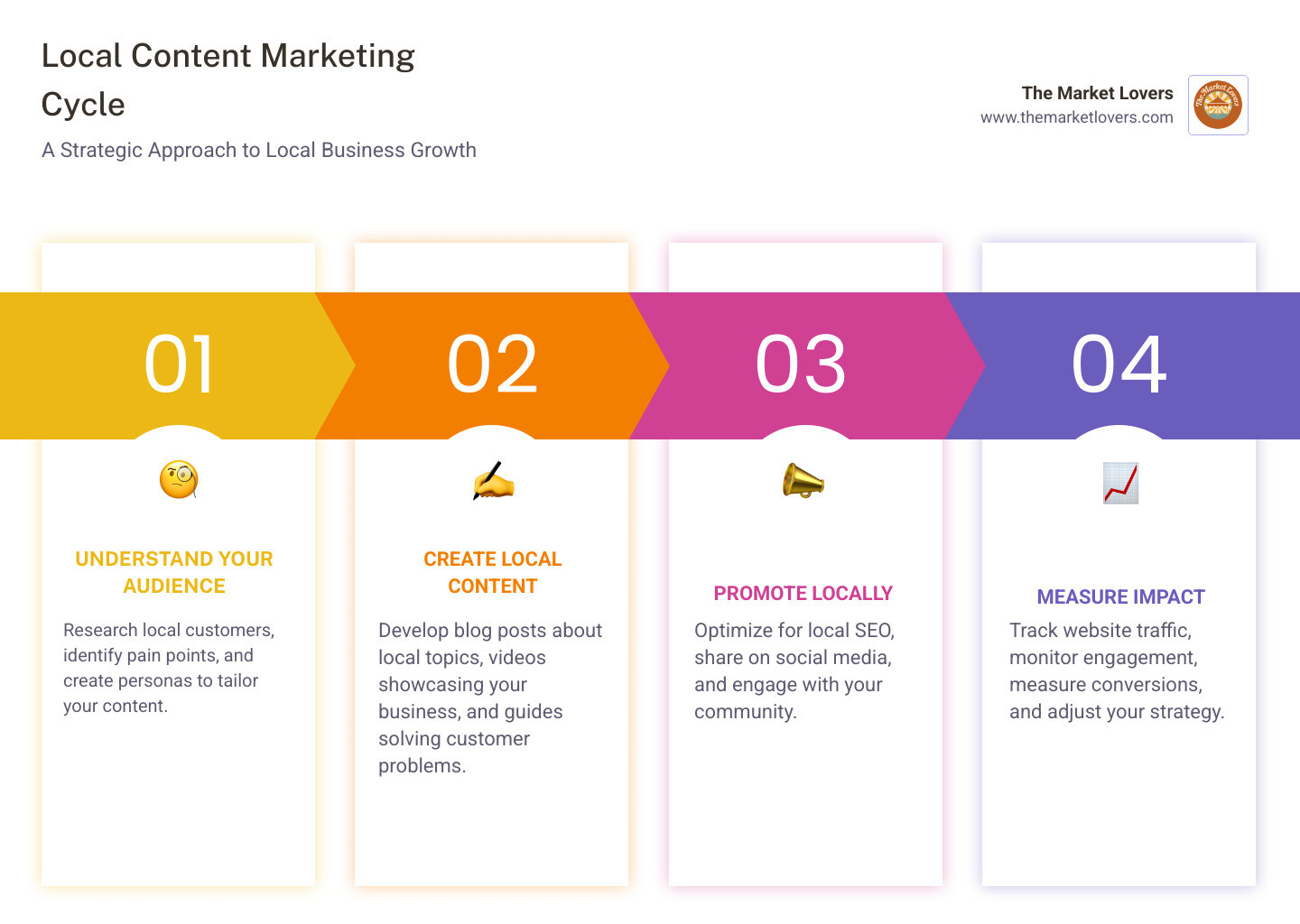
The Foundation: Setting Up for Local Content Success
Before creating content, a solid foundation is key. Your website is your online home base—it must be welcoming, easy to steer, and impressive.
First, optimize your website for today’s users. A mobile-first design is non-negotiable, as over half of web traffic is mobile. A clunky mobile site will lose customers instantly. Equally important are fast load times; aim for under 3 seconds. A slow site frustrates visitors and increases bounce rates.
Next, let’s talk about the essential pages every local business website should have. These are your foundational content assets:
- About Us page: Tell your story, connect with your audience, and showcase your values. For example, a natural foods store could detail its commitment to organic products and community involvement to attract eco-conscious shoppers.
- Contact Us page: Clearly display your full business name, address, phone number (NAP), and hours. Include all preferred contact methods (e.g., text, forms), directions, maps, and payment methods.
- NAP Consistency: Your Name, Address, and Phone Number (NAP) are vital for local SEO. Ensure they are in crawlable HTML (not an image) and consistent across all online platforms. To help search engines, mark up your NAP with Schema for better local visibility.
- Customer Service Policies: A transparent customer service policy builds trust. A 2016 survey showed that 57% of consumer complaints revolve around customer service. Publishing a customer-focused policy, like a “Customer Bill of Rights,” sets expectations and protects your reputation. You can review our Privacy Policy to understand how we handle your data.
How to Identify and Understand Your Local Audience
To create effective content, you must know who you’re talking to. Understanding your local audience makes every conversation more meaningful.
Start with market research and analyzing your existing customers. Identify their demographics, behaviors, and preferences. Use surveys, feedback, and monitoring of local online groups to find common questions and local pain points.
For example, a hardware store owner might find customers struggle with drip irrigation installation—a perfect content idea. As Aaron Weiche of GatherUp notes, offline questions are often online searches. Answering these top questions on dedicated pages can be an SEO goldmine. Tools like AnswerThePublic help find these questions.
Creating customer personas—detailed profiles of your ideal local customers—is also incredibly helpful. These are based on real data and help you tailor content directly to their needs.
Essential Content Every Local Business Website Needs
Your website is your 24/7 salesperson; stock it with content that informs, engages, and converts.

Here’s a list of foundational content assets every local business website should consider:
- Homepage Content: Your digital storefront. It must quickly convey who you are, what you offer, and why you’re the best choice, serving both quick-info seekers and deep researchers.
- Product/Service Descriptions: Create a dedicated page for each major offering. Explain benefits, not just features. Include quality images, FAQs, and clear pricing or a quote request option.
- Reviews & Testimonials Page: This is powerful social proof. With 92% of consumers now reading online reviews and 84% trusting them as much as personal recommendations, this page builds trust. Combine your own testimonials with reviews from platforms like Google and Yelp. Also, outline your terms of service for reviewers to maintain quality.
- FAQ Page: A workhorse for your site. Answer all common customer questions. A good FAQ page is helpful and keyword-rich, using the natural language of your customers.
- City Landing Pages for Service Area Businesses: Crucial for service-area businesses. Create dedicated, localized pages for each town you serve, stating “Serving [City Name]” and detailing local benefits. This “local scent” improves search rankings.
- Core Website-Based Content Assets: Beyond these, consider clear privacy policy, terms and conditions, and refund policy pages to build trust and credibility.
Creating Content That Connects and Converts
With a strong foundation, it’s time for compelling content. This is how you differentiate your brand, showcase expertise, and connect with your community.
The key is creating human-first content. Google’s algorithms, like the Helpful Content Update, reward content written for people, not search engines. Focus on E-E-A-T (Experience, Expertise, Authoritativeness, Trustworthiness). Your unique local knowledge is your superpower against generic AI content, which can lack originality and accuracy. Be the real deal.
You can also be smart by repurposing content across multiple channels. A podcast can become a video, social media snippets, or graphics. This maximizes your effort and reach.
The Most Effective Types of Content for Local Businesses
The best content meets your audience’s needs and establishes you as an authority in your industry and geography.

Here are some of the most effective types of content to create:
- Localized Blog Posts: Your blog is a cornerstone. Write about local events, community news, or relevant industry trends. For example, a bakery could blog about recipes and local food events to become a go-to source for area foodies.
- “How-To” Guides: These are highly valuable. An auto shop could create a “Winter Car Prep” guide, while a hardware store could offer a video on drip irrigation installation, driving customers to the store for supplies.
- Local Event Recaps: Recap local events like festivals or chamber meetings to show community involvement and boost local SEO. Mentioning and linking to other local businesses fosters goodwill.
- Community Stories: Highlighting local heroes, charities, or unique aspects of your town demonstrates your connection to the community.
- Customer Case Studies: Tell the story of how you solved a customer’s problem. An IT provider could detail how their software improved a client’s efficiency. Specific facts and figures add credibility.
- Local Guides: A hotel could create a “Must-See Attractions in [City]” guide, or a nature store could list local bird walks. This positions you as a knowledgeable local resource.
- Behind-the-Scenes Content: Showcasing your team, processes, or a day in the life of your business adds a personal touch and builds connection.
- Infographics: These are excellent for presenting complex information visually and are highly shareable. A financial advisor could create infographics on personal finance tips.
The Role of Video and Visuals in Local Marketing
In a text-saturated world, video and quality visuals cut through the noise. They are engaging, memorable, and effective for local marketing.
- Product Demos and How-Tos: Show, don’t just tell. A fitness studio could post workout demos. A hardware store’s video on drip irrigation is more effective than a manual.
- Behind-the-Scenes Tours: Give customers a peek behind the curtain. A quick video tour of your kitchen, workshop, or office can build trust and familiarity.
- Staff Interviews: Let your team’s personality shine. Short interviews introduce customers to the friendly faces behind the business.
- Customer Video Testimonials: These are powerful. With 84% of consumers trusting online reviews like personal recommendations, seeing and hearing a satisfied customer provides authentic social proof.
- High-Quality Photography: Images sell. Great visuals of your products or services grab attention. Google data shows listing images influence clicks, so upload them to your Google Business Profile. Use stock photo sites like Shutterstock and EyeEm or take your own.
- Infographics: As mentioned, these are great for visual learners. 67% of B2B and 62% of B2C marketers use infographics to make complex information digestible.
- Short Video Tutorials: Simple, authentic clips filmed on a smartphone work well. Genuine advice resonates more than high production value. For example, an insurance agent could post a video about niche insurance to connect with a specific audience.
Visual content is a priority: 51% of B2B and 55% of B2C marketers focus on it. Facebook posts with images see 2.3 times more engagement, and image-rich blog posts get twice the shares. It’s time to accept visuals.
Smart Promotion: A Guide to Content Marketing for Local Business
Great content is only half the battle; promotion is the other half. Smart promotion ensures local customers see your work by leveraging local SEO, social media, and email.
Leveraging Local SEO for Your Content Marketing Local Business Strategy
Local SEO is the backbone of online visibility, ensuring you appear in local searches for your offerings.
- Google Business Profile Optimization: Your Google Business Profile is your most powerful free local SEO tool. Claim and verify it, keeping all information (NAP, hours, services, photos) accurate and updated. Regularly post updates and respond to all reviews for reputation management.
- Local Keyword Research: Understand the exact phrases local customers use. Start by typing queries into search engines and noting suggestions. Use tools like Google Trends to check local search volume for keyphrases. This helps you create content around actual searches, like “best gluten-free pizza Houston.”
- Using Search Trends to Inform Content: If you spot a local trend or recurring question, create content about it. For example, a contractor could blog about local zoning laws for renovations.
- Building Local Links: Links from other reputable local businesses or community organizations to your content can significantly boost your local SEO.
- Attending Local Events: Engaging with your community by attending industry events, like Search London or Southern California SEO Meetup, can boost your local SEO strategy. You can then recap these events on your blog.
- On-Page Local Optimization: Weave local keywords naturally into your website content, title tags, meta descriptions, and image alt text. The more “local scent” your pages have, the better.
The Power of User-Generated Content in Content Marketing for Local Business
User-generated content (UGC) is authentic, trustworthy, and persuasive. It’s your customers marketing for you.
- Encouraging Customer Reviews: Since 92% of consumers read online reviews and 84% trust them like personal recommendations, actively encourage them on platforms like Google and Yelp. A simple thank-you email after a purchase can include a gentle prompt.
- Showcasing Testimonials: Feature these prominently on your website and social media. Video testimonials are especially impactful.
- Running Photo Contests with a Local Hashtag: Get customers involved with a photo contest using a local hashtag. A restaurant could ask for meal photos, or a boutique could ask for outfit pictures, generating buzz and content.
- Building Community: UGC fosters a sense of community around your brand. Seeing others engage with your business creates a positive feedback loop.
- Responding to Reviews and Engaging with Your Audience: This is crucial. Professional responses to all reviews show you care. On social media, engaging with comments and questions builds relationships.
Collaborating with Other Local Entities
Collaboration is a fantastic way to expand your reach, find new audiences, and strengthen your community position.
- Partnering with Complementary Businesses: A restaurant could partner with a winery for a joint event, or a bookstore could team up with a coffee shop. Create promotional content together.
- Co-creating Content: Invite other local business owners to contribute to your blog or podcast. This brings fresh perspectives and exposes you to their audience.
- Featuring Local Experts or Community Leaders: Interviewing a local expert or community leader for your content shows your commitment to the area and leverages their authority.
- Sponsoring Community Events: Sponsoring a local team or charity run generates goodwill and provides content opportunities. Choose sponsorships that align with your brand and audience.
- Cross-Promotion on Social Media: When you collaborate, cross-promote each other’s content on social media to efficiently expose both businesses to new audiences.
Measuring What Matters: From Clicks to Customers
You’re creating and promoting great content, but is it working? Measuring your content marketing efforts is crucial for understanding ROI and refining your strategy.
How to Measure the Success of Your Content Marketing
Defining your Key Performance Indicators (KPIs) from the start is essential. These metrics show if you’re hitting your goals.
- Using Analytics Tools: Tools like Google Analytics are your best friend. You can track:
- Website Traffic: Are more people visiting your site? Which pages are most popular?
- Engagement Metrics: How long are visitors staying? Are they interacting with your content?
- Lead Generation: Are you getting more inquiries or form submissions?
- Conversion Rates: Are more website visitors making a purchase or booking a service?
- Tracking Keyword Rankings: Are you ranking higher for your target local keywords? This indicates improved visibility in local search.
- Monitoring Social Media Engagement: Track likes, shares, comments, and mentions. Which posts generate the most interest?
- Analyzing Leads from Content: Can you attribute specific leads or sales back to a piece of content? This helps you understand its direct impact.
- Asking Customers How They Found You: Sometimes, the simplest method is most effective. A quick question at the point of sale can provide invaluable insights.
Your goals should be SMART: Specific, Measurable, Achievable, Relevant, and Time-bound. Continuously monitor performance data to make informed decisions and adapt your strategy.
How Content Builds Trust and Drives Local Traffic
Your content marketing for local business should lead to two key outcomes: building trust and driving local traffic (both online and in-person).
- Establishing Authority: By consistently providing helpful content, you establish yourself as an expert and a trusted resource.
- Solving Customer Problems: Content that addresses your audience’s pain points, like a “how-to” guide, builds goodwill and positions you as the go-to solution.
- Showcasing Authenticity: Human-first content, behind-the-scenes glimpses, and genuine customer testimonials showcase the real people behind your business, which resonates with local customers.
- Answering “I-Want-To-Go” Moments: Google’s “micro-moments” describe searches with immediate intent, including “I want to go.” Your content can address this directly. For example, a pizza place advertising a gluten-free menu online attracts customers searching for that option. Highlighting unique products or services converts online browsers into in-store visitors.
- Highlighting Positive Reviews: Showcasing positive reviews and testimonials leverages social proof to build confidence and encourage new customers.
- The Impact of Consumer Trust: When local customers trust you, they are more likely to choose you, recommend you, and become loyal customers. This trust is the bedrock of a thriving local business.
Common Pitfalls to Avoid in Your Local Content Strategy
Even with the best intentions, it’s easy to stumble. Awareness of common pitfalls helps you steer your content marketing journey smoothly.
- Inconsistency: A common mistake is starting strong and then stopping. Content marketing is a marathon, not a sprint. Maintain a consistent publishing schedule using a content calendar to plan ahead and see results.
- Not Having a Documented Strategy: Don’t create content without a clear plan. Only 32% of B2B marketers and 37% of B2C marketers have a documented content strategy. Without one, efforts are scattered. Your strategy should define goals, audience, content types, distribution, and metrics.
- Focusing Only on Sales: Content marketing is about educating and engaging, not just hard-selling. Provide value first to build trust, then guide customers toward your offerings.
- Ignoring Your Audience: Creating content that doesn’t resonate with your local customers is a waste of time. Continuously listen to their needs and tailor your content accordingly.
- Not Promoting Your Content: Even brilliant content won’t be seen if you don’t promote it. Actively share it on social media, in email newsletters, and through local SEO.
- Giving Up Too Soon: Content marketing takes time. It can take 3-6 months of regular posting to see a significant impact. Patience and persistence are key, as the long-term benefits are worth the wait.
- Expecting Overnight Results: Building authority and trust is a gradual process. Content marketing is a long-term investment that compounds over time.
Conclusion
You’ve learned how to set up your website, create engaging content, promote it, and measure its impact. It’s clear that content marketing for local business is more than a trend; it’s a powerful, cost-effective strategy for thriving in today’s digital landscape.
By embracing a human-first approach, understanding your local audience, and consistently providing value, you can build trust, foster community relationships, and drive traffic and sales. It’s a long-term investment with invaluable rewards: a loyal customer base and a respected community presence.
At The Market Lovers, we believe in empowering local businesses like yours. We understand your unique challenges and potential. Let’s work together to open up it.