

Beyond the Idea: A Comprehensive Guide to Business Startup Resources
Beyond the Idea: A Comprehensive Guide to Business Startup Resources
Business startup resources are the foundation that transforms your entrepreneurial vision into reality. Whether you’re just sketching out your first idea or already knee-deep in launching, knowing where to find the right support can mean the difference between struggling alone and building with confidence.
Top Business Startup Resources You Should Know:
- U.S. Small Business Administration (SBA) – Free 10-step guide, funding programs, and disaster assistance
- Small Business Development Centers (SBDC) – Nearly 1,000 local hubs offering free consulting
- Online Learning Platforms – Free courses from Amazon, Google, HubSpot, and Verizon
- Specialized Support – Resources for women-owned, minority-owned, and veteran-owned businesses
- Digital Tools – Website builders, SEO resources, and e-commerce platforms
- Legal & Financial Services – Tax guidance, business registration help, and loan programs
Starting a business can feel overwhelming. The paperwork, the planning, the funding, the marketing—it’s a lot. But the good news? There are hundreds of free and low-cost resources specifically designed to guide you through each step. From writing your business plan to opening your first bank account, support is available at every stage of your journey.
The challenge isn’t lack of resources—it’s knowing which ones are right for your specific situation and how to access them efficiently.
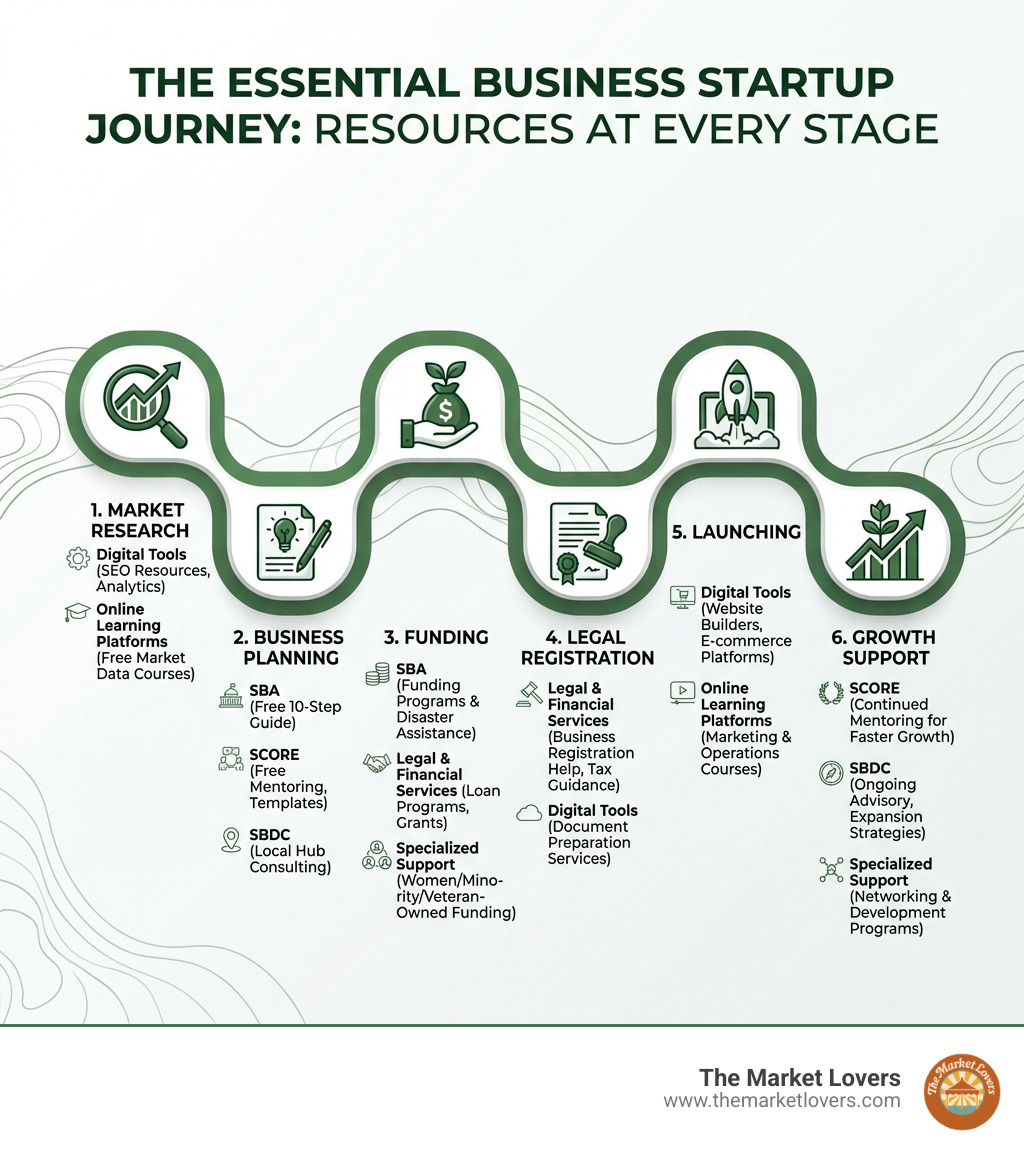
Foundational Planning & Mentorship

Every successful business begins with a solid plan and often benefits immensely from the wisdom of those who have walked the path before. For aspiring entrepreneurs, two of the most critical business startup resources are comprehensive planning tools and access to experienced mentors. These elements form the bedrock of startup success, helping you steer the often-turbulent waters of launching a new venture. Without a clear roadmap and a guiding hand, even the most brilliant idea can falter. Leveraging these resources can significantly increase your chances of not just launching, but thriving.
Crafting Your Roadmap: Business Plans & Market Research
Before you even think about opening your doors, you need a detailed plan. This isn’t just a formality; it’s your business’s blueprint. The U.S. Small Business Administration (SBA) offers a fantastic 10-step guide that explains how to plan, launch, and manage your business. This guide emphasizes the importance of market research and business plan development right from the start.
Market research is about understanding your potential customers and the competitive landscape. It helps you identify if there’s a real opportunity for your idea and how to make your business unique. For instance, you need to ask: How can I find customers for my business? How can I make my business unique? The SBA’s “Plan your business” page provides resources for data and trend analysis to help you get a competitive advantage. You can combine market research with competitive analysis to pinpoint what makes your offering stand out.
Once you have a grasp of your market, it’s time to write your business plan. A business plan is the foundation of your enterprise, serving as a roadmap for how to structure, run, and grow it. It’s also a crucial document for convincing investors or partners to support your venture. The SBA provides business plan templates to help you write one quickly and efficiently.
Another vital step in planning is calculating your startup costs. This determines how much funding you’ll need and helps you project when your business might become profitable. The SBA offers a startup cost calculator to help you identify these initial expenses. Local support networks like America’s Small Business Development Centers (SBDC) are invaluable here, offering free consulting and low-cost training that can guide you through these planning stages. America’s SBDC is a nationwide network with nearly 1,000 local hubs sponsored by top educational institutions, state economic development agencies, and private partners, all dedicated to helping entrepreneurs launch and grow businesses.
Navigating the Legal & Financial Landscape of Business Startup Resources

Once your brilliant idea is mapped out, the next hurdle is navigating the legal and financial maze of formalizing your business. This stage is crucial for ensuring compliance, securing necessary funds, and protecting your personal assets. Fortunately, numerous business startup resources are available to guide you through these essential steps, making the process less daunting. Understanding where to find information on funding options, how to register your business, and how to manage tax obligations is paramount for any new entrepreneur.
Public and Community-Based Business Startup Resources
Government agencies and community organizations are often the first and best places to turn for comprehensive support. The U.S. Small Business Administration (SBA), established in 1953, is a cornerstone for new businesses. It offers a 10-step guide that walks you through planning, launching, and managing your business. The SBA provides free or low-cost counseling and training, and helps connect business owners with local support networks.
Beyond the SBA, organizations like America’s Small Business Development Centers (SBDC) serve as local hubs for free consulting and low-cost training, helping entrepreneurs launch and grow thousands of businesses. The U.S. Chamber of Commerce also advocates for business-friendly policies and provides free resources for entrepreneurs.
For specific needs, the National Federation of Independent Businesses (NFIB) provides a business legal center, webinars, and referral services, while the National Association for the Self-Employed (NASE) offers free resources for small business owners, including access to consultants. If your business plans involve government contracts, the National APEX Accelerator Alliance has helped small businesses win over $24 billion in government contracts. These agencies are vital business startup resources that offer a wide array of support, including assistance with disaster loan applications and help with government contracting.
Securing Capital for Your Venture
One of the most pressing questions for any aspiring business owner is: Where can individuals find information on funding options for small businesses? It’s a common misconception that federal grants are readily available for starting a business. The reality is, there are no federal grants specifically for starting a business. Instead, most government financial assistance for startups comes in the form of loan support programs and local initiatives.
Small business owners typically secure capital through personal funds, finding investors, or taking out loans. The SBA plays a crucial role here by creating guidelines that allow entrepreneurs to access funding through SBA-guaranteed loans. These loans reduce the risk for local lenders, often come with lower down payment requirements, and offer flexible overhead requirements. If you’re a farmer or rancher, the Farm Service Agency loans offer specific financing options for rural businesses.
Beyond traditional loans, some organizations offer grants or scholarships. NASE, for instance, offers member-only scholarships and grants for training programs and business courses. Platforms like Verizon Small Business Digital Ready also highlight funding opportunities for entrepreneurs. When considering your options, choosing the right funding source can significantly impact your business structure and operations.
Staying Compliant: Legal, Tax, and Administrative Essentials
Launching a business involves more than just a great idea and funding; it requires meticulous attention to legal and administrative details. What are the essential legal and administrative steps required to register and operate a business?
- Choose a Business Structure: This is one of the first and most critical decisions. Your business structure (e.g., sole proprietorship, LLC, corporation) impacts your legal protections, tax obligations, and liability. The SBA’s “Launch your business” guide provides insights into choosing the right structure.
- Choose Your Business Name: Select a name that reflects your brand and is not already in use. You’ll need to protect it by registering it.
- Register Your Business: This establishes your business as a distinct legal entity. Registration requirements vary by state and business structure.
- Get Federal and State Tax ID Numbers: For most businesses, especially those with employees, you’ll need an Employer Identification Number (EIN) from the IRS. This is like a social security number for your business and is necessary for paying state and federal taxes.
- Apply for Licenses and Permits: These vary widely based on your industry, location, and specific business activities. The SBA’s guide can help you steer these requirements.
- Open a Business Bank Account: This is crucial for separating personal and business finances, ensuring legal compliance, and simplifying tax preparation.
- Get Business Insurance: Protect your business from unexpected costs due to accidents, natural disasters, or lawsuits.
Navigating tax obligations and financial management can be complex, but there are excellent business startup resources to help. The IRS Small Business and Self-Employed Tax Center is a comprehensive resource offering free tools and information for tax compliance. For human resources management, HR.com offers a free membership with e-learning lessons, webcasts, and virtual events. Many small businesses also choose to outsource specialized tasks: 71% outsource tax preparation services, and 50% outsource payroll, highlighting the complexity and importance of these areas. Legal services are also essential; resources like Rocket Lawyer and Legal Zoom offer more affordable options for legal advice and document creation compared to traditional law firms.
Essential Digital Tools & Online Growth Platforms
In today’s interconnected world, a strong digital presence is non-negotiable for business success. Small businesses must leverage online platforms and digital tools for growth, not just to compete, but to thrive. These business startup resources can help you reach customers, streamline operations, and scale your venture efficiently.
Building Your Digital Footprint
Creating a robust online presence starts with managing your business profile and building a functional website. A Google Business Profile (formerly Google My Business) is crucial for driving local customers to your brick-and-mortar store and online platform. Google for Small Business provides an abundance of information on SEO, advertising, and marketing strategies. For even more in-depth information, Google’s Applied Digital Skills platform offers free-to-access lessons to help start or grow your business, covering market research, business plans, and funding preparation.
For your website, platforms like HubSpot offer a Website Grader that can assess your site’s performance, search engine optimization (SEO), mobile functionality, and security, providing actionable insights for improvement. Social media is another powerful tool. LinkedIn, for example, is a professional-focused platform where you can showcase your company, build relationships with business customers, and highlight your expertise. They also offer a resource center packed with reports, checklists, guides, and certification programs.
E-commerce is vital for many businesses. Mastercard’s Digital Doors program provides access to financial and educational tools for online businesses, including guidance on accepting payments and enhancing cybersecurity. We know that 54% of small businesses outsource graphic design and website design, emphasizing the need for professional digital aesthetics.
Free Educational Platforms for Entrepreneurs
The digital landscape evolves rapidly, making continuous learning essential. Thankfully, many platforms offer free or low-cost educational business startup resources to keep entrepreneurs up-to-date.
- Amazon’s Small Business Academy provides a wealth of free resources, including live events, podcasts, and on-demand classes, along with access to a network of like-minded business professionals.
- HubSpot Academy offers free online courses and certification sessions for business teams, covering everything from inbound marketing to CRM.
- The MIT Open Learning Library provides free, self-paced lessons on various subjects, allowing you to expand into new industries or deepen your expertise.
- The SBA’s learning center features video courses on everything from starting up to selling your business, with many videos being just a minute long.
- Verizon Small Business Digital Ready is a one-stop resource center with over 40 online courses, coaching, networking, and funding opportunities, packed with expert guidance.
These platforms are fantastic for building skills in areas like digital marketing, financial management, and customer relations, helping you leverage online tools for growth without breaking the bank.
Specialized Support for Every Entrepreneur
Starting a business can be a unique journey for everyone, and sometimes, general business startup resources aren’t enough. Many entrepreneurs benefit from specialized support custom to their specific demographics or circumstances. This includes resources for women-owned, minority-owned, and veteran-owned businesses, as well as crucial assistance for businesses facing disaster or economic challenges.
Specialized Business Startup Resources for Diverse Founders
The entrepreneurial landscape is increasingly diverse, and dedicated resources exist to help specific groups overcome unique challenges and thrive.
- Women-Owned Businesses: Nearly 13 million businesses across the nation are now owned by women. To support this growth, SBA-funded Women’s Business Centers help level the playing field by providing access to training, education, and business resources custom for women entrepreneurs.
- Minority-Owned Businesses: There are more than eight million minority-owned businesses in the country. The Minority Business Development Agency works to connect minority business owners with contracts and financing, while advocating within the government to promote issues central to minority entrepreneurs. They offer grant competitions, a research library, and local business centers.
- Veteran-Owned Businesses: For transitioning service members (including National Guard and Reserve) or spouses, the SBA’s Boots to Business program offers foundational training. Veterans Business Outreach Centers (VBOCs) also provide support for military veterans and their families in starting, buying, and growing their businesses, including funding programs and federal contracting certifications.
- Government Contracting: For businesses looking to secure government contracts, the National APEX Accelerator Alliance has a long track record of helping small businesses win over $24 billion in contracts. This is a significant opportunity for many specialized businesses.
These specialized business startup resources ensure that diverse founders have the targeted support they need to succeed.
Support for Disaster Recovery and Economic Challenges
Life, and business, can throw unexpected curveballs. What support is available for businesses facing disaster or economic challenges? The good news is that there are robust systems in place to help businesses recover and build resilience.
The SBA is deeply committed to supporting disaster survivors in rebuilding their homes and businesses as quickly as possible. They provide crucial Home & Business Disaster Loans to help businesses recover from physical damages or economic injury caused by declared disasters. In times of crisis, the SBA offers options to fast-track disaster recovery, including a self-certification option if a local permit has been applied for more than 60 days ago without approval, helping businesses bypass permitting delays.
Frequently Asked Questions about Business Startup Resources
Are there free government grants to start a business?
No, generally there are no federal grants specifically for starting a business. Most grants are reserved for non-profits, educational institutions, and specific research or technology development. Most government support for startups comes in the form of loan support programs, like those offered by the SBA, and local programs, which help reduce the risk for lenders and provide more accessible financing options.
What is the most important first step when starting a business?
Conducting thorough market research to validate your idea and writing a comprehensive business plan are the most critical first steps. These actions form the foundation for your funding requests, marketing strategies, and overall business structure. Without understanding your market and having a clear plan, even a great idea can struggle to find its footing.
Conclusion
Starting your business is a marathon, not a sprint, but you don’t have to run it alone. We’ve seen the incredible wealth of business startup resources available, from government agencies like the SBA to specialized support for diverse founders and powerful digital tools for growth. By leveraging these resources, you can steer the challenges and build a resilient, successful enterprise.
The journey of entrepreneurship is one of continuous learning and adaptation. We, at The Market Lovers, understand the challenges and triumphs of building a business. Our mission is to empower local shopping through a connected network for small businesses, fostering a community where entrepreneurs can connect and thrive. Taking that first step, armed with knowledge and support, is the beginning of an exciting adventure. Explore our network to see how we can support your journey.
Categories:
Tags:


Building a thriving market vendor community of connected small businesses