
Why Email Marketing for Small Business Still Delivers Results
Email marketing for small business is one of the most powerful tools you can use to grow your company. If you’re wondering whether it’s worth your time, here’s what you need to know:
Quick Answer: What Email Marketing Can Do for Your Small Business
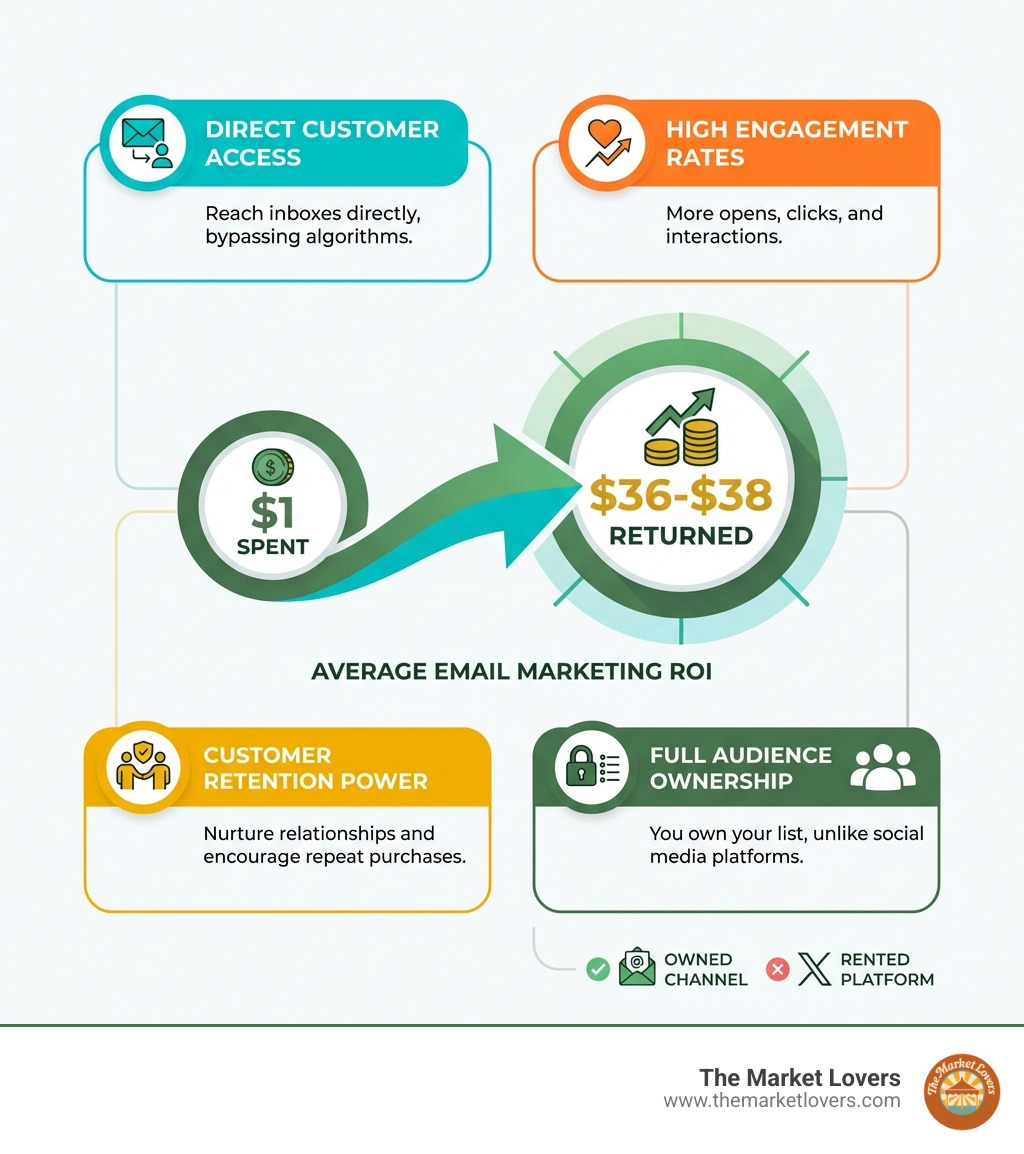
- Generate incredible ROI – Email delivers $36-$38 for every $1 spent
- Build direct relationships – Reach customers in their inbox without algorithms blocking you
- Keep customers coming back – Nurture leads and encourage repeat purchases
- Control your audience – Unlike social media, you own your email list
- Track what works – Measure opens, clicks, and conversions with simple analytics
- Scale affordably – Start free and grow as your business grows
You’ve probably heard people say email is dead. Social media took over. Nobody reads emails anymore.
They’re wrong.
While you’re building followers on platforms you don’t control, your competitors are building email lists they do control. While you’re hoping the algorithm shows your post to your audience, smart business owners are landing directly in their customers’ inboxes.
Email is where serious business happens. It’s where official communication lives. It’s where 89% of people check daily. And it’s where 52% of consumers make purchases after receiving a promotional email.
For small businesses with limited budgets, email marketing delivers outsized results without requiring a large team or expensive tools. You can start today, for free, and begin building the most valuable marketing asset your business will ever own.
Let’s show you exactly how to make it work.
Why Email Marketing is a Small Business Superpower
At The Market Lovers, we believe in empowering small businesses, and few tools offer the leverage that email marketing does. It’s not just another channel; it’s a direct line to your audience, offering control and unparalleled effectiveness.
The statistics speak for themselves: email marketing boasts an impressive 4,400% ROI. What does that mean in real terms? For every dollar you spend on your email campaign, you could see an average return of between 3600% and 3800%. Some campaigns even earn 7000% or more! This makes it one of the most cost-effective strategies for any small business owner.
Think about it: owning your audience means you’re not at the mercy of algorithms that can suddenly reduce your reach. Unlike social media platforms where your content might not even be seen by your followers, your email list is yours. You control the message, the timing, and the delivery. This direct communication fosters genuine customer retention and builds lasting loyalty.
Email is also a goldmine for data collection and personalization. Every open, click, and purchase provides valuable insights into your customers’ preferences, allowing you to tailor your messages and build stronger relationships. As Rob Davis, President and CMO at Novus Media, puts it, “Email marketing is the bridge between visibility and loyalty, connecting initial awareness efforts with conversion and re-engagement.”
Advantages Over Other Digital Channels
When we compare email marketing for small business to other digital channels, its advantages become crystal clear:
- Direct Access to the Inbox: Emails land directly in your customers’ inboxes, bypassing the noise and algorithmic filters of social media feeds. This ensures your message has a higher chance of being seen and engaged with.
- Higher Engagement: Email users are often in a more receptive mindset, looking for information or offers, compared to casual browsing on social media. This leads to higher engagement rates for well-crafted emails.
- Not Controlled by Algorithms: This is a big one! On social media, a platform’s algorithm dictates who sees your content and when. With email, you have direct control over who receives your messages, offering a stable and predictable communication channel.
- Cost-Effective at Scale: Email marketing delivers an exceptional ROI because it’s relatively inexpensive to implement, especially when you consider the potential returns. You can reach vast audiences without breaking the bank, making it perfect for small businesses.
- Fosters Two-Way Communication: Email is perhaps the closest to direct communication you can get with your customers, short of speaking to them face-to-face. It invites replies, feedback, and builds a sense of community.
- Valuable Data Insights: Email provides a controlled test pool for drawing data about campaign performance. You can easily track opens, clicks, engagement, and more, giving you the insights needed to refine your strategy continually.
The Power of Personalization and Retention
For small businesses, success isn’t just about acquiring new customers; it’s about keeping the ones you have and turning them into loyal advocates. Email marketing excels at this.
“You own your list … and you can use it to build real relationships with your audience over time,” explained Nicole Pomije, Founder of The Cookie Cups and Co-Founder of Pitch Peach. This ownership allows us to make customers feel valued by delivering content that’s specifically custom to their interests and needs.
Email provides opportunities to collect and update customer data through online forms or surveys. That data can then be used to personalize emails within your campaign, making it more likely that customers will open and click through your message. Whether it’s sharing behind-the-scenes content, new launches, or limited-time offers, email marketing keeps your brand top of mind, encouraging repeat purchases and driving valuable referrals. It’s how we nurture leads into loyal customers, turning initial interest into long-term relationships.
The Ultimate Guide to Email Marketing for Small Business
To truly harness the power of email marketing for small business, a strategic approach is essential. It’s not just about sending emails; it’s about sending the right emails to the right people at the right time.

Our guide will walk you through the key steps: starting with a solid strategy, effectively building your list, crafting compelling content, leveraging automation, and finally, measuring your success for continuous improvement.
Developing an email marketing small business strategy
Before you send your first email, we need a plan! A strong strategy is the foundation of effective email marketing for small business.
- Defining Goals: One of the most important steps is to define your campaign goals. Do you want to increase sales, drive website traffic, build brand awareness, or gather feedback? Your goals should be specific, measurable, achievable, relevant, and time-bound (SMART).
- Setting a Schedule: Consistency is key. Determine how often you’ll send emails without overwhelming your audience. For many small businesses, once a week or bi-weekly is a great starting point.
- Audience Segmentation: Not all customers are the same, so why send them the same emails? Segmenting your audience means dividing your list into smaller groups based on demographics, interests, past purchases, or engagement levels. This allows for highly targeted and relevant messages.
- Planning Content Types: Think about the different types of emails you’ll send:
- Newsletters: Regular updates, industry news, helpful tips, or behind-the-scenes glimpses.
- Promotions: Announcing sales, new products, or special offers.
- Welcome Series: A sequence of emails automatically sent to new subscribers, introducing your brand and offering initial value.
How to Build Your Email List (The Right Way)
Your email list is your most valuable asset in email marketing for small business. But how do you build it ethically and effectively?
First and foremost, a crucial warning: never consider purchasing email lists. This practice is often illegal (especially with regulations like GDPR), ineffective (these lists are usually low quality), and can severely damage your sender reputation, leading to your emails consistently landing in spam folders.
Instead, focus on organic growth:
- Opt-in Forms on Your Website: This is fundamental. Embed simple sign-up forms in your website’s header, footer, or sidebar. According to some reports, simply embedding opt-in forms can double the growth of opt-in rates.
- Website Pop-ups: While some find them intrusive, pop-ups (especially exit-intent or timed ones) are highly effective. Popovers, on average, convert emails at a rate of roughly 1.06%. Experiment with timing and design to find what works best for your audience.
- In-Person Sign-ups: Don’t underestimate the power of face-to-face interaction. Whether at a physical store, market stall, or event, asking customers if they’d like to join your email list can be very successful. Approximately 70% of people respond positively when approached this way, and emails acquired offline can have much higher click-through rates.
- Social Media Links: Include clear calls to action and links to your sign-up form on your social media profiles and posts.
- Gated Content: Offer valuable resources like e-books, white papers, webinars, or exclusive guides in exchange for an email address. This is a powerful way to acquire leads interested in your niche.
Email databases can be fickle, decaying by 22.5% every year. So, continuous list building is crucial!
Effective Incentives to Encourage Sign-Ups
People are more likely to share their email address if they get something valuable in return. What can we offer?
- Exclusive Discounts: This is often the go-to incentive. According to our research, exclusive discounts are the main reason consumers sign up for ongoing communications from brands. Small businesses typically have less red tape when making operational decisions, allowing us to easily offer compelling discounts to new registrants.
- Free Guides or Ebooks: Offering valuable information through content is a fantastic way to attract subscribers. This could be a style guide for a fashion brand, a recipe collection for a food business, or a care guide for beauty products.
- Early Access to Sales or New Products: Make your subscribers feel special by giving them a sneak peek or first dibs on new offerings.
- Free Shipping: A simple yet highly effective incentive for e-commerce businesses.
- Entry into a Giveaway: Running a contest where signing up for your email list is an entry requirement can quickly boost your subscriber count.
Crafting Emails That Convert and Engage
Once you have a growing list, the next step in email marketing for small business is to create messages that your audience actually wants to open and read.
- Compelling Subject Lines: This is your first impression! Make it intriguing, benefit-driven, or urgent to encourage opens. A/B test different subject lines to see what resonates most.
- Human-like Tone: Write as if you’re speaking directly to a friend or valued customer. Authenticity builds connection.
- Clear and Concise Copy: Get straight to the point. Most people scan emails, so use short paragraphs, bullet points, and clear headings.
- Strong Branding: Ensure your emails reflect your brand’s visual identity with consistent colors, fonts, and logos.
- Single, Clear Call-to-Action (CTA): As Mikey Lucas, Founder of American Energy Fund, advises, “Be direct about what you want them to do: ‘Schedule a call,’ ‘Click a link,’ ‘Hit reply.’ One action per email. Confused people don’t act. Clarity drives conversions.” Avoid overwhelming your readers with too many choices.
Want to learn more about crafting effective messages? Check out More info about our educational resources.
Content and Design That Resonates

The visual appeal and structure of your email are just as important as the words.
- High-Quality Images: Use engaging, relevant images that complement your message and represent your brand.
- Scannable Layout: Design your email so readers can quickly grasp the main points. Use plenty of white space, clear headings, and bulleted lists.
- Highlighting Benefits: Instead of just listing features, focus on how your product or service benefits the customer.
- Personalization Tokens: Use your subscriber’s name or other data points to make the email feel more personal. “Hi [First Name],” goes a long way!
- A/B Testing Elements: Don’t guess what works; test it! Experiment with different images, CTA button colors, or even the length of your email to see what generates the best response.
Ensuring Your Emails are Mobile-Friendly
This is non-negotiable. Forty-six percent of email opens occur on mobile now, and most people shop on their phones more often than their laptop. If your emails aren’t optimized for mobile, you’re missing a huge opportunity.
- Responsive Design: Use templates that automatically adjust to fit any screen size. Most modern email marketing platforms offer this by default.
- Single-Column Layout: This is generally best for mobile readability, as it prevents horizontal scrolling.
- Large Fonts and Buttons: Ensure your text is easy to read without zooming, and your CTAs are large enough to be easily tapped with a thumb.
- Optimizing Images for Speed: Large image files can slow down email loading times, especially on mobile data. Compress images without sacrificing quality.
Supercharging Your Efforts with Automation and Data
Once your email marketing strategy is in place, we can boost our efforts through automation and continuous optimization based on data. This saves time, scales your efforts, and ensures your messages are always timely and relevant.
Email provides valuable data, from which we can take the temperature of your campaigns, your customers, and even your competitors. Modern email marketing statistics are very simple to gather, measure, and analyze. Opens, clicks, engagement, and more can be tracked with ease across every audience segment.
The Role of Email Automation
Email automation means setting up sequences of emails that are triggered by specific actions or events. This is a game-changer for email marketing for small business, allowing you to nurture leads and customers around the clock without manual effort.
- Welcome Series for New Subscribers: Automatically send a series of emails to introduce your brand, share your story, offer a discount, and guide new subscribers on their journey with you.
- Abandoned Cart Reminders: For e-commerce businesses, these are incredibly effective. Send an automatic reminder to customers who added items to their cart but didn’t complete the purchase.
- Post-Purchase Follow-ups: Thank customers for their purchase, provide tracking information, ask for reviews, or suggest complementary products.
- Birthday or Anniversary Emails: A personalized message with a special offer can delight customers and build loyalty.
- Re-engagement Campaigns: If a subscriber hasn’t opened an email in a while, an automated series can try to win them back before you remove them from your list.
For beginners, the best tools focus on balancing ease of use with powerful automation to help you grow your audience effectively.
How to Measure Success in email marketing for small business
To know what’s working and what’s not, we need to look at the numbers. Your email service provider will give you a wealth of data.
Here are the key metrics we should track:
- Open Rate: The percentage of recipients who opened your email. This tells you how effective your subject line and sender name are.
- Click-Through Rate (CTR): The percentage of recipients who clicked on a link within your email. This indicates how engaging your content and CTA are.
- Click-to-Open Rate (CTOR): Your CTOR is the percentage of unique recipients who clicked a link after opening your email. This metric is an excellent indicator of audience engagement and resonance because it only factors in those who opened and interacted with your email content.
- Conversion Rate: The percentage of recipients who completed a desired action (e.g., made a purchase, filled out a form) after clicking a link in your email. This directly measures your campaign’s effectiveness in achieving your business goals.
- Unsubscribe Rate: The percentage of people who opted out of your list. A high rate might indicate irrelevant content or too frequent sends.
- List Growth Rate: How quickly your email list is expanding.
By regularly reviewing these metrics, we can identify trends, understand audience preferences, and make data-driven decisions to continuously improve our email marketing for small business efforts.
Staying Compliant and Maintaining a Healthy List
While email marketing for small business offers incredible opportunities, it also comes with responsibilities. We need to ensure we’re respecting privacy, complying with regulations, and keeping our list healthy to avoid deliverability issues.
Legal Considerations: CAN-SPAM and GDPR
Ignoring email marketing laws can lead to hefty penalties and damage your brand’s reputation.
- CAN-SPAM Act (United States): This law establishes requirements for commercial messages, gives recipients the right to have emails stopped, and spells out tough penalties for violations. Key provisions include:
- No false or misleading header information.
- No deceptive subject lines.
- Tell recipients where you’re located (include a valid physical postal address).
- Tell recipients how to opt out of receiving future emails.
- Honor opt-out requests promptly.
- General Data Protection Regulation (GDPR) (European Union): This comprehensive privacy law, which went into effect May 25, 2018, impacts any business that collects or processes data from EU citizens, regardless of where the business is located. For email marketing, the highlights are:
- Consent must be freely given, specific, informed, and unambiguous. This usually means an unchecked box, clearly stating what the user is signing up for.
- You must clearly identify who is sending the email.
- Provide an easy way to withdraw consent (unsubscribe).
- Only collect necessary data.
- Be able to prove consent was given.
Always ensure your emails are set up to follow these acts to avoid any penalties.
Best Practices for a Healthy and Engaged List
A healthy email list is one that is engaged, responsive, and free of invalid addresses. This is critical for good deliverability and strong ROI.
- Regularly Cleaning Your List: Email databases are constantly decaying. Regularly remove inactive subscribers (those who haven’t opened or clicked in a long time) and invalid or bounced email addresses. This improves your deliverability rates and ensures you’re sending to people who want to hear from you.
- Removing Inactive Subscribers: If someone hasn’t engaged with your emails for 6-12 months, consider a re-engagement campaign. If they still don’t respond, it might be time to remove them.
- Honoring Unsubscribes Immediately: Not only is this legally required (CAN-SPAM, GDPR), but it’s also good practice. Frustrated subscribers can mark your emails as spam, harming your sender reputation.
- Using Double Opt-in: This means that after someone signs up, they receive a confirmation email asking them to click a link to verify their subscription. This ensures you have genuine interest and helps prevent spam traps or fake sign-ups.
- Monitoring Bounce Rates: A high bounce rate indicates a lot of invalid email addresses. Your email service provider will typically handle hard bounces (permanently undeliverable) automatically, but keep an eye on soft bounces (temporary issues).
Frequently Asked Questions about Email Marketing for Small Businesses
What are the best types of emails for a small business to send?
For email marketing for small business, we recommend a mix of value and promotion. Start with a welcome series for new subscribers to introduce your brand. A regular newsletter with helpful tips, industry insights, or behind-the-scenes updates builds rapport. Occasional promotional emails for sales, new products, or special offers are also crucial. Don’t forget transactional emails like order confirmations or shipping updates, which are expected and highly opened.
How often should a small business send marketing emails?
There’s no single answer, but consistency is key. We suggest starting with once a week or bi-weekly and watching your engagement rates (opens and clicks). The goal is to stay top-of-mind without overwhelming your audience. Avoid long periods of silence followed by a flood of emails, as this can lead to unsubscribes. Adjust your frequency based on what your audience responds to best.
Can I do email marketing for free?
Absolutely! Many email service providers offer free plans that are perfect for small businesses just starting out or with smaller lists. These plans typically have limits on subscribers or monthly sends but include essential features like templates, list management, and basic reporting. Some popular free options include MailerLite (up to 1,000 subscribers, 12,000 emails/month), Brevo (unlimited contacts, 300 emails/day), or HubSpot (up to 1 million subscribers, 2,000 emails/month with CRM). These free tiers are fantastic for getting started and learning the ropes without a significant financial commitment.
Conclusion
So, is email marketing for small business still important? A resounding yes! It’s a foundational digital marketing strategy that offers an incredible return on investment, a direct connection to your audience, and the power to build lasting customer relationships. From defining your strategy and building your list to crafting compelling content and leveraging automation, the steps are clear.
Don’t let the noise of other channels distract you. Make email a marketing priority as soon as possible. This program can take a little time to pick up momentum, but once you start collecting email addresses and sending campaigns, you’ll quickly gain traction.
At The Market Lovers, we’re here to help you steer the landscape of small business growth. Start building your email list today, empower your business, and watch your connections grow.